Touareg life
Touareg found in Africa
Black Skin White heart
Courage and love the desert
Total population : 5.2 million
in algeria we have
 Algeria
 : 1,025,000 (1987)

Tuareg territory
The Tuareg people inhabit a large area covering almost all the middle and western sahara and the north-central sahel . In Tuareg terms, the Sahara is not one desert but many, so they call it
Tinariwen ("the Deserts"). Among the many deserts in Africa there is the true desert
tenere. Then we can cite numerous deserts more and less arid, flat and mountainous:
Adrar, Tagant, Tawat (
Touat)
Tanezruft,
Adghagh n Fughas,
Tamasna,
Azawagh, Adar,
Damargu,
Tagama, Manga, Ayr,
Tarramit (Termit),
Kawar, Djado,
Tadmait,
Admer,
Igharghar,
Ahaggar,
Tassili N'Ajjer,
Tadrart,
Idhan,
Tanghart, Fezzan,
Tibesti,
Kalansho, Libyan Desert, etc.

Culture
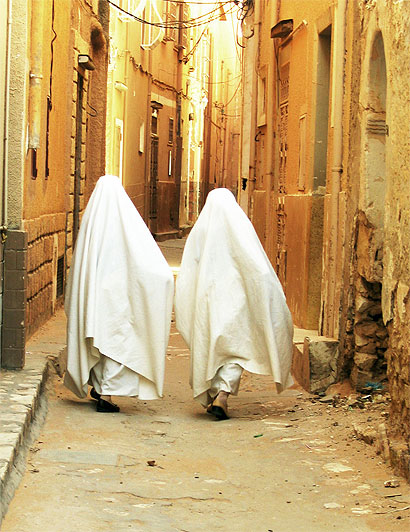
The Tuareg are matrilineal, though not matriarchal. Unlike many Muslim societies, women do not traditionally wear the veil, whereas men do. The most famous Tuareg symbol is the Tagelmust(also called éghéwed in Malian Tamasheq, or referred to as a Cheche, pronounced: Shesh from Berber), an often blue indigo coloured veil called Alasho. The men's facial covering originates from the belief that such action wards off evil spirits, but most probably relates to protection against the harsh desert sands as well; in any event, it is a firmly established tradition (as is the wearing of amulets containing verses from the Qur'an). Men begin wearing a veil when they reach maturity which usually conceals their entire face excluding their eyes and the top of the nose.
Tuareg people have a very personal wedding, there's an unspoken law about other people not interfering with marriage. The only tradition they know is a 'quarantine' period after one's husband's/wife's death. The widow is supposed to make something whereby her husband should be remembered during this period, and she's not to see other men. Men usually have to cleanse themselves physically and mentally. Nor was there a common punishment for women or men who were unfaithful. Although Tuareg aren't supposed to have more than one lifepartner (a relationship is practically equal to an engagement and once you're a couple you're expected to get married) it is highly unusual for them to stay single. When a partner passes away, they are expected to get married again (when the quarantine is finished). If there are no potential partners or the widow or widower is too old to get married there are exceptions.
Many Tuareg today are either settled agriculturalists or nomadic cattle breeders; though there are also blacksmiths and caravan leaders.
The Tuareg are sometimes called the "Blue People" because the indigo pigment in the cloth of their traditional robes and turbans stained the wearer's skin dark blue. Today, the traditional indigo turban is still preferred for celebrations, and generally Tuaregs wear clothing and turbans in a variety of colors.
Language
The Tuareg speak Tamajaq/Tamasheq/Tamahaq, a southern Berber language having several dialects among the different regions. The Berber dialects spoken in the Rif (Tamazight), Atlas and Souss regions of Morocco differ somewhat from each other and also from the Tuareg dialects spoken further south. Berber is an Afro-Asiatic language like Semitic languages, Chadic languages and Pharaonic Egyptian. The language is called Tamasheq by western Tuareg in Mali, Tamahaq among Algerian and Libyan Tuareg, and Tamajaq in the Azawagh and Aïr regions, Niger. The Tamajaq writing system, Tifinagh (also called Shifinagh), descends directly from the original Berber script used by the Numidians in pre-Roman times
Religion
The Tuareg are predominantly Muslim and generally follow the Maliki madhhab.
Arts
Much Tuareg art is in the form of jewelry, leather and metal saddle decorations called Trik, and finely crafted swords. The Inadan community makes traditional handicrafts. Among their products are: Tanaghilt or Zakkat (the 'Agadez Cross' or 'Croix d'Agadez'); the Tuareg Takoba, many beautiful gold and silver-made necklaces called 'Takaza'; and earrings called 'Tizabaten'.
In 2007, Stanford's Cantor Arts Center opened an exhibition, "Art of Being Tuareg: Sahara Nomads in a Modern World," curated by Tom Seligman, Director of the center, who first spent time with the Tuareg in 1971 when he traveled through the Sahara after serving in the Peace Corps. The exhibition includes beautifully crafted and adorned functional objects such as camel saddles, tents, bags, swords, amulets, cushions, dresses, earrings, spoons and drums.[8] The exhibition is also being shown at UCLA Fowler Museum in Los Angeles and the Smithsonian’s National Museum of African Art in Washington DC.
Across History the Tuareg are renowned and respected warriors. Their decline a military Might came with the introduction of the fire arms, weapons which the Tuareg do not possess. The Tuareg warrior attire consists of a Takoba (sword), Allagh (lance) and Aghar (shield) made of antelope's skin.
Traditional music
Traditional Tuareg music has two major components: the moncord violin Anzad played often during night parties and a small tambour covered with goatskin called Tende, performed during camel races and horse races. and other festivities. Traditional vocal songs called Asak (songs), and Tisiway (poems) sung by women and men during feats and social occasions. Another popular Tuareg musical genre is Takamba, characteristic for its Afro-Berber percussions.
Tinariwen, a Tuareg band that fuses electric guitars and indigenous musical styles, was founded in the 1980s by rebel fighters. Tinariwen is one of the best known and authentic Tuareg bands. Especially in areas that were cut off during the Tuareg rebellion (eg Adrar des Iforas), they were practically the only music available, which made them locally famous and their songs/lyrics (eg Abaraybone, ...) are well known by the locals. [9] They released their first CD in 2000, and toured in Europe and the United States in 2004. The Niger-based band Etran Finatawa combines Tuareg and Wodaabe members, playing a combination of traditional instruments and electric guitars.
Many music groups emerged after the 1980s cultural revival. Among them Tartit, Imaran and known artists are: Abdallah Oumbadougou from Ayr, Baly Othmany of Djanet.
Tuareg Music genres, Music groups and artists
- Majila Ag Khamed Ahmad, singer Asak (vocal music), of Aduk, Niger
- Almuntaha female Anzad (Tuareg violin) player, of Aduk, Niger
- Ajju female Anzad (Tuareg violin) player, of Agadez, Niger
- Islaman singer, genre Asak (vocal music), of Abalagh, Niger
- Tambatan singer, genre Asak (vocal music), Tchin-Tabaraden, Niger
- Alghadawiat female Anzad (Tuareg violin) player, of Akoubounou, Niger
- Taghdu female Anzad (Tuareg violin) player, of Aduk, Niger
- In Tayaden singer and guitar player, Mali
- Kiddu Ag Hossad singer and guitar player, Mali
- Baly Othmani singer, luth player, Djanet Algeria
- Abdalla Ag Umbadugu, singer and guitar player, Agadez, Niger
Music and Culture Festivals
The Desert Festival in Mali's Timbuktu provides one opportunity to see Tuareg culture and dance and hear their music.
Other festivals include:
- Cure Salee Festival in the oasis of In-Gall, Niger
- Sabeiba Festival in Ganat (Djanet) Algeria
- Shiriken Festival in Akabinu (Akoubounou) Niger
- Takubelt Tuareg Festival in Mali
- Ghat Festival in Aghat (Ghat) Libya
- Festival au Desert in Mali
- Ghadames Berber and Tuareg Festival in Libya
Games
Tuareg Traditional Games include:
- Tiddas a game played with small stones and sticks.
- Izagag a game played with small stones or dried fruits.
- Iswa a game played by picking up stones while throwing another stone.
- Melgha a game where children hide themselves and another tries to find and touch them before they reach the well and drink.
- Tabillant traditional Tuareg wrestling
- Alamom wrestling while running
- Solagh another type of wrestling
- Tammazaga or Tammalagha race on camel back
- Takket consists of staying awake singing and playing all night.
- Takadant a game that makes children try to imagine what the others are thinking.
- Shishagheren consists of writing the name of one's lover to see if this person brings good luck.
- Taqqanen telling devinettes and enigmas.
- Maru Maru young people mime how the tribe works.


 The old traditional way
 Ceramic artifacts, some of the participants in the training course

 How to make a template
 Artists Spain
 Opening day
 On the way to the city of targeting
 this is the desert of Tamanrasset